

We are Fertilidad Integral
We are a specialized fertility clinic. We combine science, experience, and a human approach to support you every step of the way.
The ROPA method is one of the most innovative fertility treatment options for female couples. This technique, an acronym for Reception of Oocytes from the Partner, allows both women to participate biologically in the conception process, creating a unique bond with their future baby. In this comprehensive guide, we will explore every aspect of the ROPA method, from how it works to the legal and medical requirements, as well as success rates and associated costs.
What is the ROPA Method?
The ROPA method (Reception of Oocytes from the Partner) is an assisted reproduction treatment specifically designed for female couples who wish to share motherhood biologically. This procedure allows one woman to provide her eggs (becoming the genetic mother) while the other partner receives the resulting embryos and carries the pregnancy (becoming the gestational mother).
This technique has revolutionized shared motherhood options, as before its development, female couples wishing to have children had to decide who would be the biological mother, with no possibility for both to participate in the biological process. The ROPA method has shifted this paradigm, allowing for truly shared motherhood from a biological standpoint.
In today's context of family diversity, the ROPA method represents a significant advancement that recognizes and respects different ways of building a family, offering female couples an option specifically tailored to their needs and desires.
How much does the ROPA method treatment cost in Mexico?
In Mexico, the ROPA method is performed in private clinics specializing in fertility treatments. The total cost of the treatment generally ranges between 180,000 and 220,000 Mexican pesos, excluding medication, which can be an additional expense of between 30,000 and 50,000 pesos.
The price of the ROPA method includes several components:
- Initial and follow-up medical consultations (first visit and subsequent assessments)
- Diagnostic tests (hormonal analysis, ultrasounds, etc.)
- Follicular puncture
- Laboratory fertilization (IVF or ICSI)
- Embryo culture
- Embryo transfer
- Pregnancy test
Additionally, there may be extra costs such as:
- Medication for ovarian stimulation and endometrial preparation
- Preimplantation Genetic Testing (PGT), if performed
- Vitrification and storage of surplus embryos
- Frozen embryo transfers in subsequent cycles
It is important for couples to be fully informed about the costs before starting treatment and to consider the possibility that more than one attempt may be needed to achieve pregnancy.
In which cases does it apply?
The ROPA method is specifically designed for female couples who wish to biologically share the experience of creating life. It is ideal when:
- Both wish to participate actively in the reproductive process
- One woman has a better ovarian reserve and the other has optimal uterine conditions
- They are looking for a truly shared motherhood from a biological perspective
- They meet the established medical and legal requirements
- They want an alternative to treatments where only one would have a biological link
At Fertilidad Integral, we evaluate each case on an individual basis during the first visit, considering both medical aspects and the couple's preferences to determine if the ROPA method is the best option for their fertility journey.
How does the ROPA method work?
The ROPA method combines elements of traditional in vitro fertilization (IVF) with egg donation, with the unique feature that the donor and the recipient are a couple. The process begins with ovarian stimulation of one of the women (the genetic mother) to obtain several eggs. These eggs are retrieved via follicular puncture and fertilized in the laboratory with donor sperm from a certified sperm bank.
The resulting embryos are cultured for several days in specialized incubators and then transferred to the uterus of the recipient woman, whose endometrium has been previously prepared to receive them. If implantation is successful, this woman will carry the pregnancy and give birth to the baby.
What makes the ROPA method special is that it allows both women to have a biological bond with the baby: one through genetics, by providing her genetic material, and the other through gestation, by providing the intrauterine environment where the baby will develop for nine months. This dual biological bond is what distinguishes the ROPA method from other assisted reproduction techniques available to female couples.
Phases of the ROPA method
Phase 1: Initial fertility assessment
The ROPA method process begins with a comprehensive fertility assessment of both women during the first visit. This study is essential to determine who will be the egg donor (genetic mother) and who will be the recipient (gestational mother). During this phase, various medical tests are performed on both women, including:
- Complete hormonal analysis
- Transvaginal ultrasounds to evaluate ovarian reserve and uterine health
- Blood tests to rule out infectious diseases
- Karyotype study to rule out chromosomal abnormalities
- Medical and gynecological history evaluation
Generally, it is recommended that the younger partner or the one with better ovarian reserve donates the eggs, as egg quality declines with age. On the other hand, the partner who will carry the pregnancy should have a healthy and receptive uterus. However, this decision may vary based on each individual case, taking into account factors such as age, ovarian reserve, uterine health, and, of course, the couple's personal preferences.
Phase 2: Ovarian stimulation of the genetic mother
Once it has been decided who will be the egg donor, the ovarian stimulation process begins. During this phase, the genetic mother receives hormonal treatment with gonadotropins to stimulate the development of multiple ovarian follicles, rather than the single follicle that develops in a natural cycle.
The treatment usually lasts between 10 and 12 days, during which the patient must administer daily subcutaneous injections. Throughout this period, monitoring is performed via transvaginal ultrasounds and blood tests to track follicular growth and adjust medication dosages if necessary.
Potential side effects of the medication include abdominal bloating, ovarian discomfort, mood swings, and, in rare cases, ovarian hyperstimulation syndrome. However, with proper monitoring, these effects are usually mild and manageable.
Phase 3: Follicular puncture and egg retrieval
When the follicles have reached the appropriate size (generally around 18-20 mm), an hCG hormone injection is administered to trigger the final maturation of the eggs. Approximately 36 hours later, the follicular puncture is performed to retrieve the eggs.
Follicular puncture is an outpatient procedure performed under sedation. Using an ultrasound-guided needle, the doctor accesses the ovaries through the vagina and aspirates the follicular fluid containing the eggs. The procedure lasts approximately 15-20 minutes.
After the puncture, the patient remains under observation for a few hours and may experience some discomfort such as mild abdominal pain, vaginal spotting, or fatigue. Relative rest is recommended for 24 hours, and strenuous physical activity should be avoided for the following days.
Phase 4: Fertilization and embryo culture
Once the eggs are retrieved, they are taken to the laboratory where they are fertilized with a semen sample from an anonymous donor. Fertilization can be performed using two techniques:
- Conventional IVF: eggs and sperm are placed together in a culture dish so that fertilization occurs naturally.
- ICSI (Intracytoplasmic Sperm Injection): a single sperm is injected directly into each egg. This technique is used when few eggs are available or to maximize the chances of fertilization.
The resulting embryos are cultured in specialized incubators for 3-5 days. During this time, embryologists monitor embryo development and select the most viable ones for transfer. Selection criteria include the speed of cell division, cell symmetry, and the absence of fragmentation.
In some cases, preimplantation genetic testing (PGT) may be performed to analyze the embryos and rule out chromosomal abnormalities before transfer.
Phase 5: Endometrial preparation of the gestational mother
While the ovarian stimulation process is underway for the genetic mother, the gestational mother begins her endometrial preparation. The goal is to synchronize her cycle so that the endometrium (the inner lining of the uterus) is in optimal condition to receive the embryos.
Endometrial preparation is carried out through the administration of estrogen and progesterone, which mimic the natural hormones of the menstrual cycle. Estrogen promotes endometrial growth, while progesterone prepares it for implantation.
During this phase, periodic ultrasounds are performed to check endometrial thickness, which ideally should be greater than 7-8 mm to promote implantation. The endometrial pattern may also be evaluated, looking for a trilaminar appearance that indicates receptivity.
Endometrial preparation is crucial for the success of the ROPA method, as a receptive endometrium significantly increases the chances of embryo implantation.
Phase 6: Embryo transfer
Embryo transfer is the moment when the selected embryos are placed into the gestational mother's uterus. It is an outpatient procedure that does not require anesthesia and lasts approximately 15-20 minutes.
During the transfer, the doctor inserts a thin, flexible catheter through the cervix until it reaches the uterine cavity. The embryos, suspended in a culture medium, are deposited inside the uterus. The entire process is performed under ultrasound guidance to ensure the precise placement of the embryos.
Generally, one or two embryos are transferred, depending on factors such as the egg donor's age, embryo quality, and the couple's preferences. The current trend is toward transferring a single embryo to reduce the risk of multiple pregnancy.
After the transfer, the patient rests for about 15-30 minutes and can subsequently resume normal life, although it is recommended to avoid strenuous physical activity, baths, and sexual intercourse for the following days.
Phase 7: Pregnancy test and follow-up
Approximately 10-14 days after the embryo transfer, a blood test is performed to detect the beta-hCG hormone, which confirms whether pregnancy has occurred. A positive result indicates that at least one embryo has successfully implanted.
In the event of a positive result, an ultrasound is scheduled at 6-7 weeks of gestation to confirm that the pregnancy is progressing correctly and to verify whether it is a single or multiple pregnancy. From this point on, the patient is monitored by the obstetrics department for routine pregnancy follow-up.
If the result is negative, the medical team will evaluate the case to determine the possible causes of implantation failure and assess options for future attempts, such as the transfer of embryos frozen via vitrification, if any are available.
Requirements for accessing the ROPA method
Legal requirements
In Mexico, the ROPA method is permitted under the regulations for assisted reproduction techniques. To access this technique, couples must meet certain legal requirements:
- The women must be in a stable relationship and provide proof of their partnership.
- Both women must be of legal age and have full legal capacity.
- Both must sign an informed consent form, accepting the terms of the treatment and acknowledging the legal parentage of the future baby.
It is important to note that legislation regarding assisted reproduction varies by country. In some countries, the ROPA method is not permitted or is subject to different regulations. Therefore, it is essential to be informed about the legislation in effect in each specific case.
Medical requirements for the genetic mother
The woman who will provide the eggs (the genetic mother) must meet certain medical requirements to ensure egg quality and the success of the treatment:
- Preferably under 35 years of age, as egg quality decreases significantly after this age.
- Good ovarian reserve, assessed through hormonal analysis (AMH, FSH) and antral follicle count via ultrasound.
- Absence of transmissible genetic diseases.
- Absence of transmissible infectious diseases (HIV, hepatitis B and C, syphilis).
- Good general state of health.
To evaluate these aspects, various medical tests are performed during the first medical visit, such as hormone analysis, ultrasounds, genetic testing, and serological studies.
Medical requirements for the gestational mother
The woman who will carry the pregnancy (gestational mother) must also meet certain medical requirements to ensure a healthy pregnancy:
- A healthy and receptive uterus, free of malformations, fibroids, or other conditions that could hinder implantation or the development of the pregnancy.
- Age preferably under 45, although this limit may vary depending on the fertility clinic and the patient's health status.
- Absence of diseases that could complicate pregnancy (uncontrolled hypertension, diabetes with vascular involvement, etc.).
- Absence of absolute contraindications for pregnancy.
- Good general state of health.
To evaluate these aspects, tests such as ultrasounds, hysteroscopies, hormone analysis, and a general medical evaluation are performed.
ROPA method success rates
Success rates for the ROPA method are comparable to or even higher than those of conventional IVF, mainly because patients are typically young and without fertility issues. In general, it is estimated that the pregnancy rates per transfer range between 50% and 60%, although these figures can vary significantly depending on various factors.
The main factors influencing the success of the ROPA method are:
- Age of the egg donor: This is the most decisive factor, as egg quality decreases with age. Success rates are significantly higher when the donor is under 35.
- Endometrial quality of the recipient: A receptive endometrium with an appropriate thickness and pattern promotes embryo implantation.
- Quality of the transferred embryos: Good-quality embryos with proper development and no fragmentation are more likely to implant.
- Experience of the medical team and the embryology laboratory.
It is important to keep in mind that these rates refer to clinical pregnancies (confirmed by ultrasound) and not necessarily to live births. The miscarriage rate is approximately 15-20%, similar to that of natural pregnancies.
Fertilidad Integral ROPA Method Results
At Fertilidad Integral, our success rates reflect our commitment to the medical excellence and cutting-edge technology that define every treatment. As part of our philosophy of radical transparency, we share our actual results so you have clear information about what to expect on your fertility journey.
2024 Highlights: With euploid embryos, we have achieved a 65.7%² pregnancy rate per transfer, a result that underscores the consistency and quality that set us apart. This achievement is built on our comprehensive approach, which combines:
- Embryo Predict™ technology with artificial intelligence for embryo selection
- A laboratory with meticulous quality control and rigorous safety protocols
- Personalized support throughout the entire process
Our overall rates:
- Pregnancy rate per embryo transfer: 53%
- Pregnancy rate per low-complexity treatment: 19.1%
These figures represent the result of over 12 years of experience, a specialized team, and our commitment to providing patient-centered care. Every case is unique, and during your first visit, we will evaluate your specific situation to provide you with realistic and personalized expectations.
Psychological and emotional aspects of the ROPA method
The ROPA method has significant psychological and emotional implications for the couples who choose it. One of the main advantages is that it allows both women to have a biological bond with the baby, which can strengthen the feeling of shared motherhood and reduce potential asymmetries in the relationship with the child.
The genetic mother provides her genetic material, passing on her physical and genetic traits to the baby. The gestational mother, meanwhile, provides the intrauterine environment where the baby develops, influencing their development through epigenetics (changes in gene expression without altering the DNA) and establishing a prenatal bond during the nine months of pregnancy.
However, the process can also present emotional challenges:
- Anxiety and stress during treatment, especially at key moments such as the follicular puncture, embryo transfer, or waiting for the results.
- Worry about potential complications or the outcome of the treatment.
- Managing expectations and preparing for the possibility that the treatment may not be successful.
- Adapting to the roles of shared motherhood.
For these reasons, many clinics offer psychological support throughout the process, helping couples manage their emotions, resolve doubts, and prepare for motherhood. This support can be especially valuable during difficult times or if the treatment is not successful in the first few attempts.
Who does the baby look like with the ROPA method?
One of the most frequently asked questions about the ROPA method concerns the physical characteristics of the future baby. The baby will inherit genetic characteristics exclusively from the mother who provided the egg (genetic mother) and from the sperm donor.
Inherited characteristics:
- Physical traits: eye color, hair, height, and facial structure from the genetic mother
- Genetic predispositions: both positive traits and hereditary conditions
- Donor characteristics: selected with physical compatibility in mind
The role of the gestational mother: Although the gestational mother does not provide genetic material, her role is fundamental. During pregnancy, she influences the baby's development through:
- Epigenetics: environmental factors that can turn certain genes on or off
- Nutrition and care: which impact intrauterine development
- Prenatal bonding: establishing an emotional connection from gestation
This biological duality ensures that both women have a unique connection to the baby—one genetic and one gestational—creating a complete and special family bond.
Differences between the ROPA method, IVF, and Artificial Insemination
For couples of women looking to start a family, there are different assisted reproduction options available. Each has specific characteristics that make it more suitable depending on the circumstances and wishes of each couple.
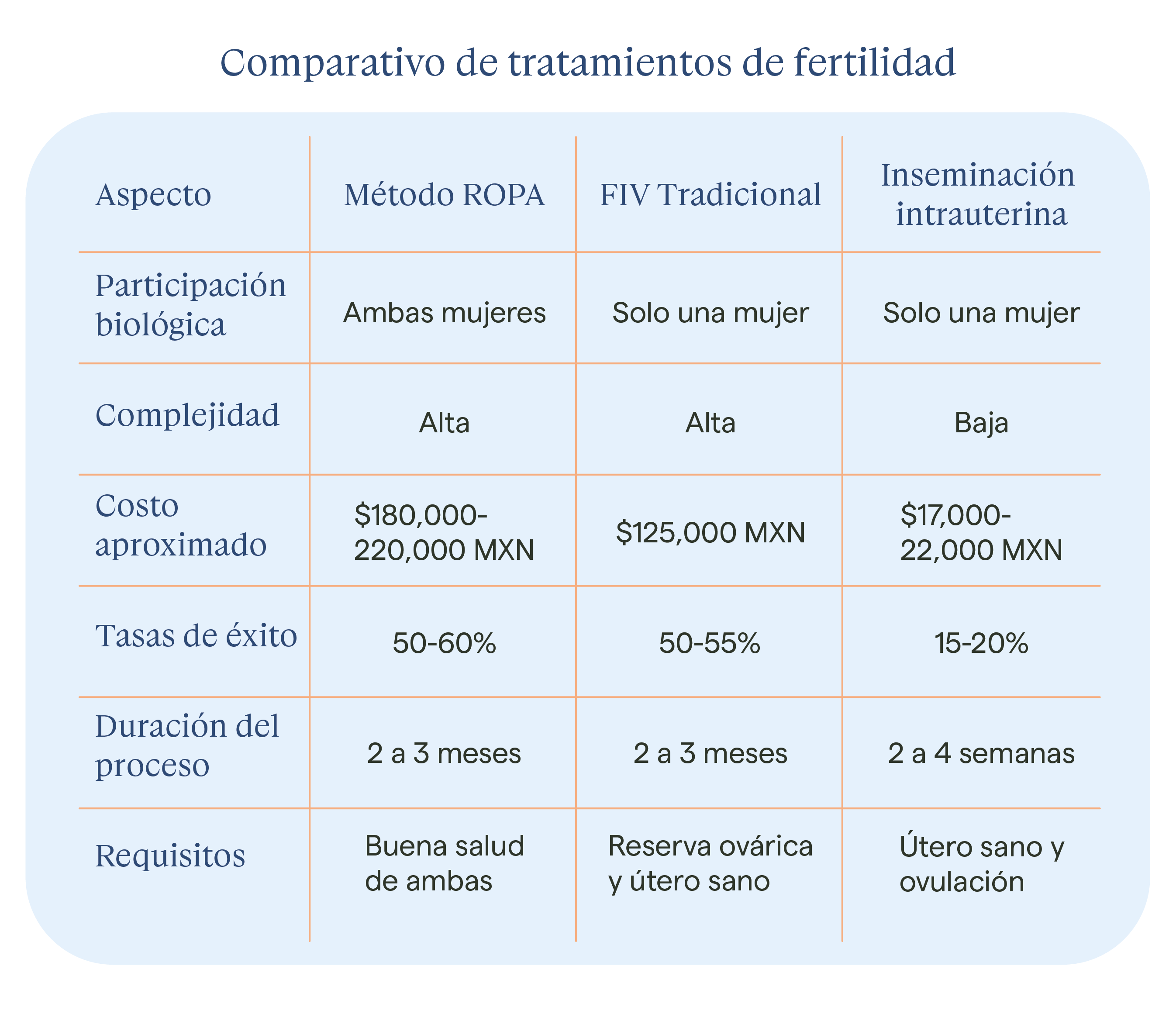
Details of each alternative:
ROPA method:
- Unique advantage: Allows for shared biological motherhood
- Ideal for: Couples who want active participation from both partners
- Process: One partner donates eggs, the other carries the pregnancy
- Consideration: Requires synchronization of both women's cycles
IVF with own eggs:
- Characteristics: Eggs and pregnancy from the same woman
- Advantage: More direct process, only one woman medically involved
- Limitation: The other partner has no biological involvement
- Option: Who carries the process can be alternated in future attempts
Artificial Insemination with Donor:
- Simplicity: Outpatient procedure, less invasive
- Cost: More affordable
- Efficiency: Lower success rates, may require multiple attempts
- Ideal forCouples with normal fertility looking for simplicity
ROPA Method specialized clinics in Mexico
In Mexico, Fertilidad Integral stands out as the pioneering clinic offering the ROPA method with the most advanced technology. With a presence in Mexico City,GuadalajaraandMetepec, Fertilidad Integral has over 12 years of experience and is the first international clinic outside the United States to incorporate Embryo Predict™ artificial intelligence embryo selection technology.
Fertilidad Integral offers:
- Experience and specialization in the ROPA method
- Success rates above international standards
- Cutting-edge technology, including state-of-the-art incubators
- Personalized care and comprehensive support throughout the process
- Full transparency regarding costs and procedures
- Multidisciplinary team including specialized psychologists
The clinic is distinguished by its holistic approach that goes beyond the medical aspect, offering nutritional, psychological, and wellness support throughout the entire process.
When choosing a fertility clinic, it is advisable to consider factors such as:
- Experience and specialization in the ROPA method
- Published success rates
- Available technology and equipment
- Personalized care and support throughout the process
- Transparency regarding costs and procedures
- Reviews and experiences from other patients
It is advisable to schedule an initial visit to meet the medical team, get your questions answered, and feel comfortable with your choice.
Same-sex marriage in Mexico and access to the ROPA method
Mexico has been a pioneer in Latin America in recognizing family diversity. With the legalization of same-sex marriage across the country, female couples have found new opportunities to build families through specialized fertility treatments.
The growth of the ROPA method in Mexico:
- 2022: Approximately 42,148 assisted reproduction procedures were performed
- 2023: The fertility market grew by 9.5% annually
- 2024: IVF reached USD 152.4 million, including methods such as ROPA
- 2025: Increased demand driven by inclusion and the visibility of diverse families
Favorable legal framework: In Mexico, the ROPA method is fully permitted for female couples who meet the established requirements. Couples can:
- Access treatments without restrictions based on sexual orientation
- Establish clear legal parentage for both mothers
- Receive specialized and respectful medical care
At Fertilidad Integral, we celebrate this diversity and have developed specialized protocols to meet the unique needs of every family, regardless of their structure or composition.
Why choose Fertilidad Integral for your ROPA treatment?
If you are interested in the ROPA method or other fertility treatments, we recommend consulting with specialists at Fertilidad Integral who can offer you personalized information based on your situation. Remember that every case is unique and deserves individualized attention.
With locations in Mexico City, Guadalajara, and Metepec, Fertilidad Integral offers the experience, technology, and human warmth necessary to support you on your fertility journey.
Schedule your first visit and discover how we can help you make your dream of starting a family a reality.
ROPA Method FAQs
How long does the entire ROPA method process take?
The entire process takes between 2-3 months from the first consultation to the embryo transfer. At Fertilidad Integral, our team will support you through every stage, including initial evaluations, cycle synchronization, and all necessary procedures.
Is the ROPA method painful?
The procedures are outpatient with minimal discomfort. The egg retrieval is performed under conscious sedation, and the embryo transfer is completely painless. You may experience mild discomfort similar to menstrual cramps, which is easily managed with common painkillers.
Can I choose the sperm donor's characteristics during the ROPA method?
Yes, you can select basic physical characteristics of the donor such as height, eye color, hair, and build. At Fertilidad Integral we work with certified sperm banks that allow for this matching based on the couple's preferences.
What happens if I have leftover embryos during the ROPA method?
Good-quality embryos are frozen using vitrification, a preservation technique we use in our laboratories. This allows you to make future attempts without repeating the entire process, saving significant time and costs.
Can I exercise during ROPA method treatment?
Gentle exercise such as walking or yoga is recommended, while high-impact activities should be avoided. After the transfer, relative rest for 24-48 hours is advised, and intense exercise should be avoided for two weeks. Our wellness team can design a routine that is right for you.
Does the ROPA method affect hormones in the long term?
No. The hormones used are temporary, and your levels return to normal after the treatment. There are no permanent effects on your natural hormonal system.
When can I take a home pregnancy test after the ROPA method?
It is important to wait for the scheduled blood test (10-14 days post-transfer). Home tests can give false positives due to the treatment hormones. At Fertilidad Integral we schedule this test at the precise time for reliable results.
What happens if the first ROPA method attempt is unsuccessful?
Our medical team will evaluate your specific case, analyze potential protocol adjustments, and discuss options such as frozen embryo transfer or a new full cycle. Every situation is unique and deserves personalized attention.
Can I travel during ROPA method treatment?
Long-distance travel should be avoided 48 hours before and after key procedures. For international patients, we recommend planning a 2-3 week stay. Fertilidad Integral has specialized coordinators to facilitate the process for patients traveling from other countries.
Will the baby have health problems because they were conceived using the ROPA method?
No. Babies conceived through the ROPA method have the exact same health prospects as those conceived naturally. All standard prenatal check-ups and medical monitoring are performed.
How many attempts does the ROPA method allow?
There is no set limit for ROPA method attempts. The decision depends on individual medical factors, the patients' ages, response to previous treatments, and the couple's emotional and financial considerations. At Fertilidad Integralwe evaluate each case personally to determine the best options. Many couples achieve pregnancy on the first or second attempt, while others require more cycles. The important thing is that each attempt is carried out with protocols optimized based on your previous experience.